
Currently Empty: ₨ 0

In the hustle of our modern lives, food has largely become a matter of convenience. We eat on the go, often choosing snacks based on vibrant packaging or an immediate sugar rush, rarely pausing to consider the origin of what we consume. There is a disconnect between the consumer in the city and the source of their sustenance. However, a quiet shift is taking place. It is a movement that seeks to reconnect us with the earth and with the people who cultivate it. This is the essence of snacking with purpose.
When you open a package of walnuts or dried apricots from Organica, you are doing far more than satisfying a mid-afternoon craving. You are engaging in a powerful act of economic and social solidarity. You are casting a vote for sustainable agriculture, for the preservation of ancient farming traditions, and for the livelihoods of communities in Pakistan’s remote north. This article explores the journey of your food from the pristine valleys of Gilgit-Baltistan to your home, highlighting how a simple choice to eat organic can ripple outwards to create meaningful change.
The Hidden World Behind Your Snack
To truly understand the value of the produce offered by Organica, one must first understand the unique terroir of Gilgit-Baltistan (GB). This region is often romanticized for its tourism potential, known for the towering peaks of K2 and Nanga Parbat, but its true wealth lies in its soil and its people. The agriculture of this region is unlike anywhere else in the world, defined by a harsh yet giving landscape that demands resilience.
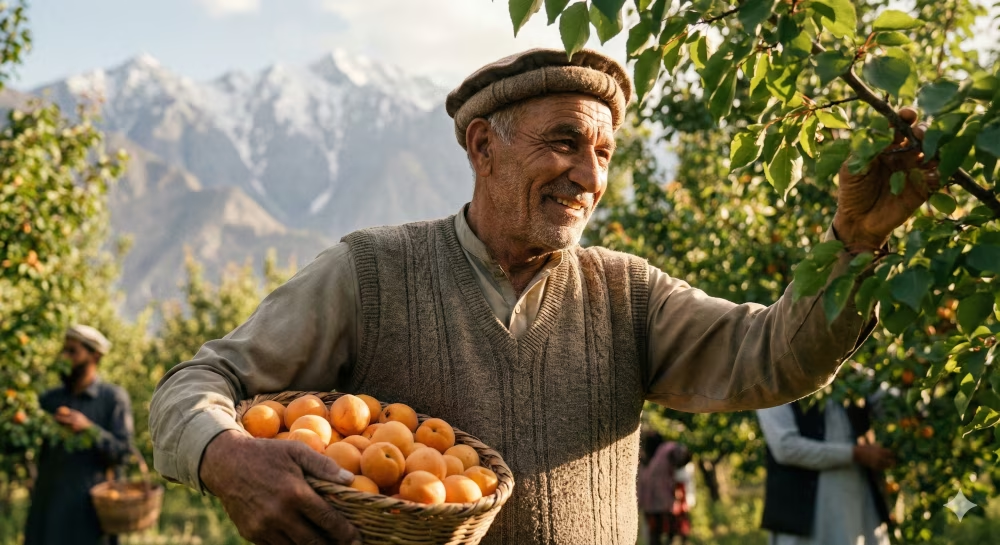
The fruits grown here, specifically in valleys like Skardu, Hunza, and Ghizer, are not products of industrial farming. There are no massive machinery combines or crop-dusting planes. Instead, agriculture here is an intimate dance with nature. The orchards are often small, family-owned plots that have been passed down through generations. These trees are watered not by stagnant reservoirs, but by glacial meltwater that rushes down from the ice caps. This water is incredibly pure and rich in minerals, infusing the soil with nutrients that are eventually absorbed by the fruit trees.
This specific environment creates a flavor profile and nutrient density that is impossible to replicate in the plains. The high altitude, often ranging between 1,500 to 3,000 meters, means the air is thinner and cleaner. The significant drop in temperature at night slows the respiration of the plants, allowing them to store more sugars and nutrients in the fruit. When you bite into an Organica apple or apricot, you are tasting the result of this struggle against the elements. It is a concentration of flavor that speaks of the mountains themselves.
However, the beauty of the landscape often hides the difficulty of life within it. For decades, the farmers of Gilgit-Baltistan have faced a paradox. They grow some of the finest organic produce on earth, yet they have struggled to find a market that values it. The remoteness that gives the fruit its purity also acts as a barrier. Roads are often blocked by landslides, electricity is intermittent, and access to modern cold storage is limited. For a long time, this meant that tons of premium fruit would rot on the ground or be sold for pennies to opportunistic middlemen who did not care about the farmer’s welfare.
The Economic Lifeline: Bridging the Gap
This is where the mission of Organica becomes vital. By establishing a direct supply chain with farmers in Skardu and surrounding areas, we are working to dismantle the barriers that have kept these communities economically isolated. The concept of “Fair Trade” is often discussed in global markets, but its application within Pakistan is just as critical.
When you purchase from Organica, you are bypassing the layers of exploitation that typically exist in the food supply chain. In the traditional model, a farmer might sell his walnuts to a local agent, who sells to a transporter, who sells to a wholesaler in Rawalpindi, who then sells to a retailer. At every step, the price increases, but the profit margin for the farmer remains negligible. By the time the consumer buys the product, the person who planted the tree and harvested the crop sees only a tiny fraction of that value.
Organica disrupts this model. We source directly. This ensures that the financial benefits of the transaction flow back to the source. For a farmer in a remote village, this difference is life-changing. An increased income means being able to afford better tools and safer harvesting equipment. It means having the financial cushion to survive a harsh winter. Most importantly, it means being able to invest in the next generation.
In many of these agrarian communities, education is valued highly, but it is expensive. The additional income generated from selling premium dry fruits at fair prices allows families to send their children to school and college. It is a direct link between the snack in your hand and a child’s education in the mountains. By snacking with purpose, you are fueling a cycle of literacy and opportunity that can transform the future of the region.
Empowering the Women of the North
The story of agriculture in Gilgit-Baltistan is incomplete without acknowledging the backbone of the industry: the women. While men often handle the heavy lifting of plowing and transportation, the delicate art of harvesting, cleaning, sorting, and drying the fruit is almost exclusively the domain of women.
The production of dried apricots, for example, is a labor-intensive process that requires immense skill and patience. The fruit must be picked at the perfect moment of ripeness. It is then washed, halved, and laid out on rooftops to dry under the intense mountain sun. This process, known locally as sukha, turns the fresh fruit into a shelf-stable powerhouse of nutrition.
Historically, this labor was unpaid, considered simply part of the household chores. However, as Organica and similar initiatives create a structured market for these products, this labor is gaining economic recognition. When we source products like dried mulberries, cherries, and apricots, we are validating the traditional skills of these women.
Economic independence for women in rural areas has a profound ripple effect on community health and stability. Studies consistently show that when women control a portion of the household income, they are more likely to spend it on nutrition, healthcare, and education for the family. By creating a demand for the products that women process, Organica is helping to elevate their status within the community. Your choice to buy these products is a silent salute to the thousands of women who work on rooftops across the valley, turning the harvest of the summer into the sustenance of the winter.
The “Organic” Difference: Health Over Hype
In the crowded aisles of supermarkets, the word “organic” is often used as a marketing gimmick, stamped on packages to justify a higher price tag. But in Gilgit-Baltistan, organic is not a label. It is a way of life that has existed for centuries.
The farmers in these valleys do not use synthetic pesticides, herbicides, or chemical fertilizers. There are two main reasons for this. First, the isolation of the region has historically made these industrial chemicals expensive and difficult to obtain. Second, and more importantly, the farmers understand their land. They know that the soil is living, fed by the breakdown of organic matter and the mineral-rich waters. They use natural manure from their livestock to fertilize the trees, maintaining a closed-loop system that is sustainable and safe.
This stands in stark contrast to conventional dry fruit farming in other parts of the world, where crops are often drenched in chemicals to maximize yield and uniformity. Conventionally grown apricots are frequently treated with sulfur dioxide to preserve their bright orange color. While they may look appealing, this chemical treatment can trigger asthma and allergic reactions in sensitive individuals, and it alters the natural taste of the fruit.
Organica’s apricots from Skardu are brown. They are dark, rugged, and perhaps less “perfect” looking than their factory-processed counterparts. But this color is the badge of their purity. It signifies that they have been dried naturally in the sun, without sulfur. When you eat them, you are ingesting nothing but the fruit itself, with all its vitamins and enzymes intact.
The health implications of switching to these natural snacks are profound. We are currently living through a health crisis in Pakistan, with rising rates of diabetes, heart disease, and hypertension. Much of this can be traced back to a diet high in processed foods, refined sugars, and unhealthy fats. Snacking is often the biggest culprit. We reach for biscuits, chips, or sugary drinks to get us through the day.
Replacing these empty calories with nutrient-dense dry fruits is one of the simplest and most effective changes you can make for your health. Walnuts, for instance, are incredibly rich in Omega-3 fatty acids, which are essential for brain health and reducing inflammation in the body. Almonds provide a hit of Vitamin E and magnesium. Mulberries are a surprising source of iron and Vitamin C. These are not just snacks; they are functional foods that actively work to repair and protect your body.
Sustainability and Environmental Stewardship
Snacking with purpose also requires us to look at the environmental footprint of our food. In an era of climate change, the distance our food travels and how it is grown matters more than ever.
When you buy imported dry fruits—perhaps almonds from California or figs from Turkey—you are participating in a global supply chain that consumes vast amounts of fossil fuels. These products are flown or shipped thousands of kilometers, stored in energy-intensive climate-controlled warehouses, and packaged in heavy plastics.
In contrast, sourcing from Gilgit-Baltistan significantly reduces “food miles.” By supporting local Pakistani produce, you are minimizing the carbon emissions associated with transportation. You are also supporting a form of agriculture that is inherently climate-resilient. The mixed-crop orchards of GB are diverse ecosystems. Farmers often grow vegetables and fodder crops beneath the canopy of fruit trees. This biodiversity promotes soil health and provides a habitat for pollinators like bees and butterflies.
Furthermore, the traditional irrigation systems of the region are a marvel of sustainable engineering. The kuhls (water channels) use gravity to guide water from the glaciers to the fields, requiring zero electricity. This is a sharp contrast to the tube wells used in the plains, which deplete the water table and consume massive amounts of energy. By choosing Organica, you are supporting a system that works with the planet, not against it.
A Call to Conscious Consumption
We live in a world where we can buy almost anything with a tap on a screen. This convenience often breeds apathy. We forget that every rupee we spend is a vote for the kind of world we want to live in.
When you choose to snack with purpose, you are making a conscious decision to value quality over quantity. You are choosing to value the health of your body over the fleeting pleasure of processed sugar. You are choosing to value the livelihood of a farmer in Skardu over the profits of a multinational food conglomerate.
At Organica, our role is simply to be the bridge. We handle the logistics, the quality control, and the packaging to ensure that the harvest of the North reaches you in pristine condition. We manually sort every batch to ensure you get the best quality, and we package our products to retain freshness without artificial preservatives. But the real power lies with you, the consumer.
Imagine the impact if every household in Pakistan replaced just one processed snack a day with a handful of locally grown organic dry fruit. The demand would revitalize the agricultural economy of Gilgit-Baltistan. It would encourage more young people to stay in the region and continue the farming traditions of their ancestors. It would lead to a healthier population and a cleaner environment.
This is the vision behind Organica. We are not just selling dry fruits; we are selling a connection. We are inviting you to become part of a story that spans generations and geography.
So, the next time you feel a pang of hunger, pause for a moment. Do not just grab the nearest packet of chips. Think about the mountains. Think about the glacial water. Think about the hands that harvested the fruit. Choose a snack that nourishes you and empowers a community. Choose to snack with purpose.
Your body will thank you, and somewhere in a high valley of Gilgit-Baltistan, a farmer will thank you too.
“To eat is a necessity, but to eat intelligently is an art.” François de La Rochefoucauld